Held hostage by mistake: my bizarre extortion story with a Cambodian vape shop
The first warning
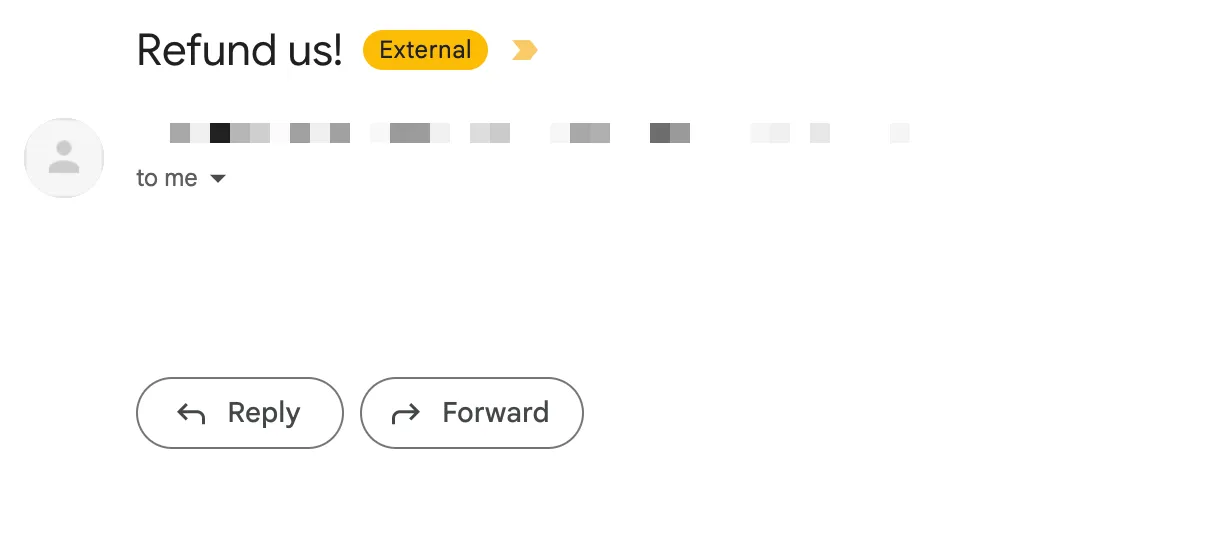
On August 25th, 2025, a cryptic email landed in my inbox. The subject line was “Refund us,” and the body was completely empty. I didn’t think much of it and assumed my spam filter was having an off day.
A few days later, things got more serious. I received a notification from Google Maps: my business had been given a 1-star rating. I immediately noticed the reviewer’s name matched the sender of the strange email. At this point, it looked like a coordinated review-bombing attack. I reported it to Google and went to bed, hoping that would be the end of it.
It wasn’t.
The demand
A few days later, a third email arrived, and this one left no room for interpretation. It stated that I needed to refund them 1500$, or else they would “go to police and warn others on social media.” I have to admit, I found it funny that the email started with “Dear Artem” - at least they didn’t forget their manners.
This direct threat got my attention. This was no longer just a disgruntled person with a grudge; this was an extortion attempt (or so I thought).
The investigation
I immediately started to investigate. First, I checked my own records. In the entire 15 years I’ve been helping businesses with marketing, there was absolutely no mention of this “client.” No invoices, no emails, no transactions. Nothing.
Next, I checked out the sender’s website (which I won’t link to here). It appeared to be a legitimate vape e-commerce company based in Cambodia. After carefully reviewing the email headers, it appeared that the messages were authentic and not spoofed (you can always paste email headers into AI and ask it to analyze them). They were genuinely coming from this business. At this point, it was either:
- They had their business email account hacked and used for extortion, or
- They were affiliated with this business, and this was their “side gig.”
I was leaning towards the former, so I decided to make contact. Their official Telegram account seemed genuine, with many posts and promotions.
The confrontation and the twist
I initiated a conversation and was politely greeted by somebody on the other side of the world. However, after I explained the situation, our not-so-polite conversation made one thing clear: they believed they had been scammed by someone who used the handles ArtemAppsGeyser and TgBoost, and they had somehow concluded it was me.
It was a case of mistaken identity. They weren’t after me; they were after a scammer who just happened to share my first name.
I tried explaining that I had never taken money from them and that they had the wrong person, but they refused to listen. The conversation ended abruptly when they told me to “F*** off” and blocked me. While their review has since been deleted from Google Maps, I am still thinking about this business in Cambodia.
The truth revealed: A sophisticated scam network
I decided to explore further using Claude AI’s research mode. What I uncovered was far more unsettling than simple mistaken identity. The handles ArtemAppsGeyser and TgBoost are not just random usernames; they are confirmed elements of a sophisticated, coordinated fraud operation.
ArtemAppsGeyser is a completely fabricated entity, impersonating a legitimate company to gain false credibility. TgBoost, on the other hand, operated as a dissolved UK shell company with multiple red flags, including a virtual office address known for fraudulent operations and a director from a high-risk region.
This network systematically targets individuals and businesses, promising social media growth services, then demanding upfront cryptocurrency payments (like USDT). Once paid, they disappear. Numerous documented cases reveal victims losing hundreds of dollars through identical methods. My case, demanding 1500$ in cryptocurrency, fits their established pattern perfectly. These aren’t legitimate service providers; they are deliberate fraud operations designed to steal money.
A cautionary tale
Let my bizarre experience serve as a cautionary tale for every small business owner. It’s a stark reminder of how vulnerable we are to online attacks. If you ever find yourself in a similar situation, never give in to digital extortion. Your first step should be to file a police report to get a case number; this documentation is critical when contacting review platforms like Google to back up your case and protect your reputation.
As for me, I will try to contact the vape shop one more time, because I want to hear their side of the story. And if the representative from that shop in Cambodia happens to be reading this: I am truly sorry that someone scammed you. Please answer my email, as I want to hear what happened and maybe I can help somehow.