Open-source AI is becoming a commodity. What I actually run.

A month ago I argued that open-source AI has to win. This is the receipt: the model I actually run now, what it costs, and the flat-rate plan that quietly changed how I pay for any of it.
A month ago I wrote a long piece about why open-source AI has to win. That was the argument - privacy, cost, reliability, and the politics of who controls the compute. I am not going to re-run it here. If you want the why, it is still up.
This is the part that comes after the argument: what I am actually running, one month into the bet. A thesis is cheap. The real question is whether I put my own daily work on it, and I did.
Open-weight is not the same as free
The thing that got me thinking again was a podcast, “Who is Afraid of Chinese Models?” One line in it is worth repeating, because it corrects a lazy idea a lot of people are walking around with: open-weight does not mean free. You can download a Chinese model, yes. But running it is not free - inference is a real cost of goods, in a way it never really was for normal software. The podcast put Kimi K3 at $3 per million tokens in and $15 out, cheaper than Sol’s $5/$30, and then made the sharper point: the number that matters is not the price of a token, it is the price of a solved task. Hold that thought. It comes back at the end.
What I am actually running
In June, GLM 5.2 was a line on a leaderboard to me. I mentioned it as the open model topping the coding index, but the model I actually recommended was 5.1. A month of running 5.2 changed that.
Here is the honest verdict, and I am keeping it boring on purpose: it is good enough. GLM 5.2 is the first open model where I opened it up, gave it my real work, and did not feel a big difference. Not for everything - anyone doing more exotic things than me will find the edges faster - but for how I actually work, day to day, it holds. The spec I care about most is the context window, because my setup churns through a lot of information at once, and 5.2 gives me a million tokens of it.
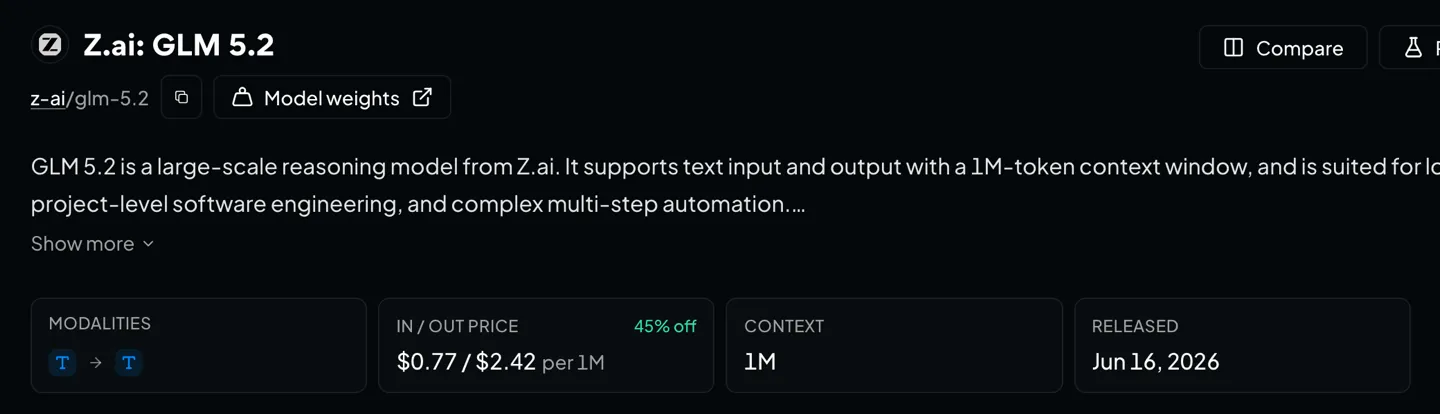 GLM 5.2 on OpenRouter: $0.77 in and $2.42 out per million tokens, a million-token context, released 16 June 2026. The 45% is a provider discount off the $1.40/$4.40 list.
And it is cheap. Not “cheap for what it is” cheap - actually cheap. $0.77 per million tokens in, $2.42 out, a million-token context, released in the middle of June. That is the whole reason it stopped being a hobby and became my daily driver the moment my Anthropic quota ran out. (That is still how all of this starts, by the way. I hit a wall on Anthropic, and I go looking.)
Kimi K3 made noise the same month, supposedly nearly beating Fable on benchmarks. I have not run it, and I do not trust benchmarks - providers optimise for the test - so I am not going to have an opinion yet. I will tell you what I think when I have actually used it.
This is turning into hosting
Now the part that is genuinely new since June, and the reason I think this whole market is about to change shape.
Go to OpenRouter, pick GLM 5.2, and look at who is serving it.
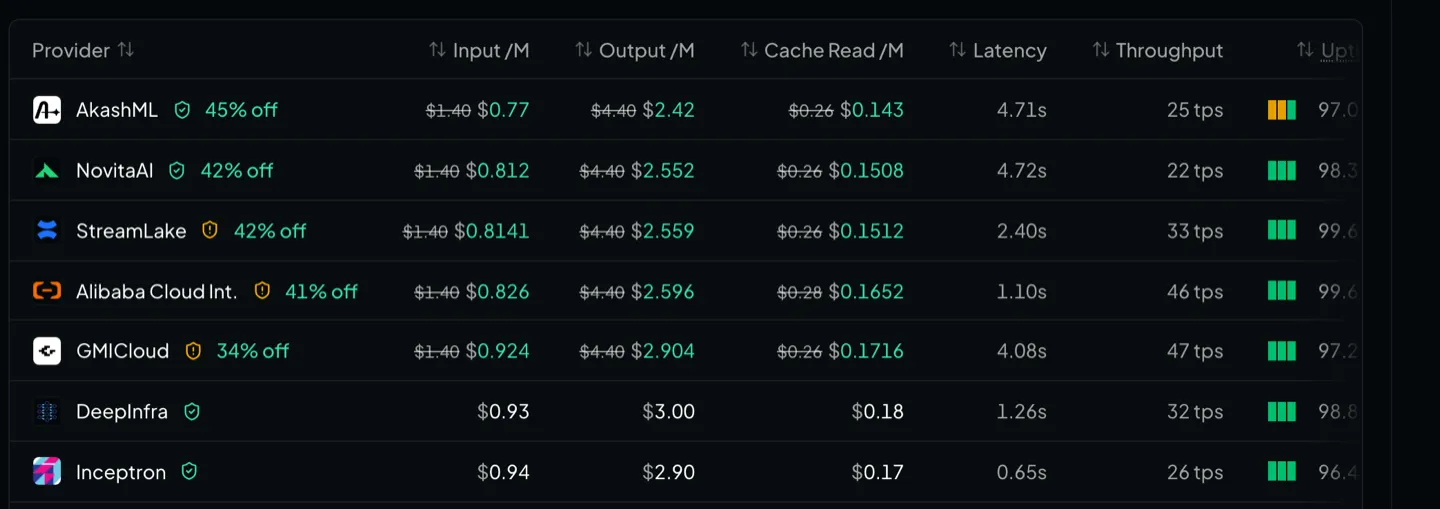 Half a dozen providers hosting the same GLM 5.2, from $0.77 to $0.93 per million in, competing on price, latency and throughput.
That is not one company selling you a model. That is half a dozen companies selling you the same model, and the only things they compete on are price, uptime, and how fast it runs on their hardware. AkashML at $0.77, the next at $0.81, another at $0.93. You can tell OpenRouter “I do not care if it is a little slow, give me the cheapest,” and it shops for you.
If that sounds familiar, it should. It is hosting. Open-source software that anyone can run, and a thousand companies competing to run it for you at five dollars, ten dollars, racing the price down - that is WordPress. That is the entire web-hosting industry. Inference is turning into exactly that, and the token price is going one direction: down.
The unlock I did not expect
Here is where it got interesting for me personally.
In June I complained about a specific trap: per-token pricing kept falling, but agentic workloads exploded the number of tokens, so the bill went up anyway. The market has an answer now, and I did not expect its shape.
The creators of GLM, z.ai, sell a flat-rate coding plan.
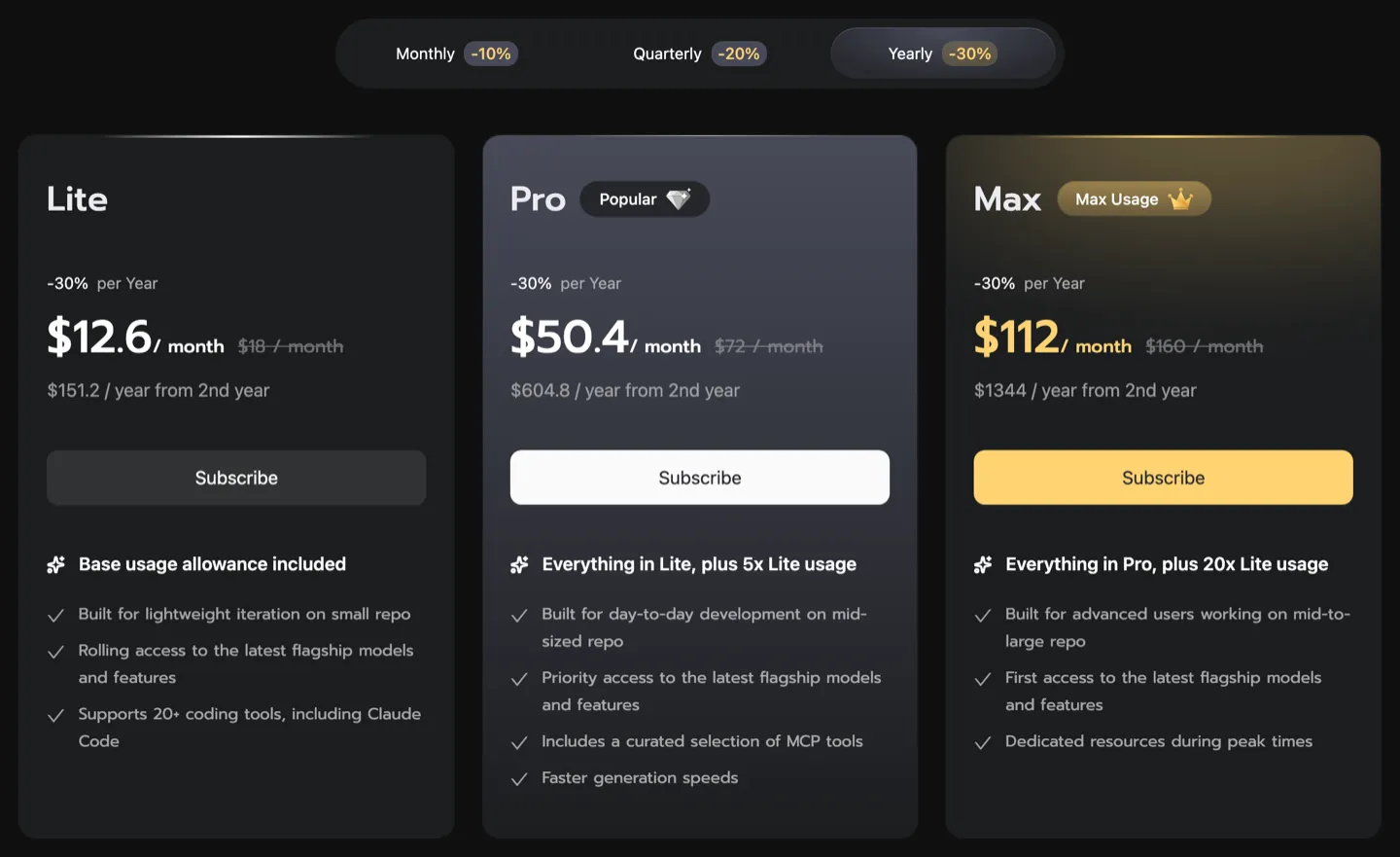 z.ai’s GLM Coding Plan. The Lite tier is $18 a month, or $12.60 if you commit to a year (they run 10, 20 and 30% off for monthly, quarterly and annual).
$18 a month for the entry plan, less if you pay ahead. I did not commit to a year - locking a year to one AI model when the whole field turns over every week is dreaming - so I pay the monthly rate. Fixed price, generous quota, and you stop watching a meter.
But the thing that made me sit up was not the price. It was that the plan hands you a real API key.
That sounds small. It is not. Normally a subscription like this authenticates through a terminal and never gives you the key - you are locked to their app. z.ai gives you an actual key, and within the plan quota you can point it at whatever you want. That is the difference between renting a seat and holding a key.
Think of it as a ladder, the same one from June. Frontier API -> an open model through a router -> a lab’s own key on a flat plan -> rented GPUs -> your own hardware. Each rung buys a little more independence for a little more effort. OpenRouter was step one, a compromise rung, still a third party in the middle. A real key on a flat plan is the next rung up, and it is a genuinely nice place to stand.
The honest catch
I want to be straight about the catch, because there are two, and skipping them would be selling you a free lunch that does not exist.
The first is the rules. These plans are personal-use only. Not for reselling, not for handing the key to your whole team, not for putting the model behind a product you charge for. And they enforce it: usage is watched, and suspicion alone, not proof, is enough for them to throttle you, freeze the account, or ban it, with no refund. So take this as a description of where the market is heading, not as a how-to. If you are building anything real or commercial on it, you use the proper pay-as-you-go API or a written agreement. Full stop.
The second is privacy, and this is the one I would not wave away. A cheap, capable model with generous quotas from a provider you know almost nothing about is an agreement with the devil. Good price, good limits, and you should assume anything you send it might be used to train the next model. I do not put anything sensitive through these plans, and neither should you. The economics are great. The trust is not there, and pretending otherwise is how people get burned.
Worth saying: because GLM 5.2 is an open model, you are never locked into z.ai to run it. Any of those OpenRouter providers will serve it. The coding plan is just the cheapest way in right now, with the nicest unlock attached.
Where this goes
I think we get more of what z.ai accidentally showed me: fixed-price, all-you-can-eat access to open models, with a real key you can wire into your own workflows.
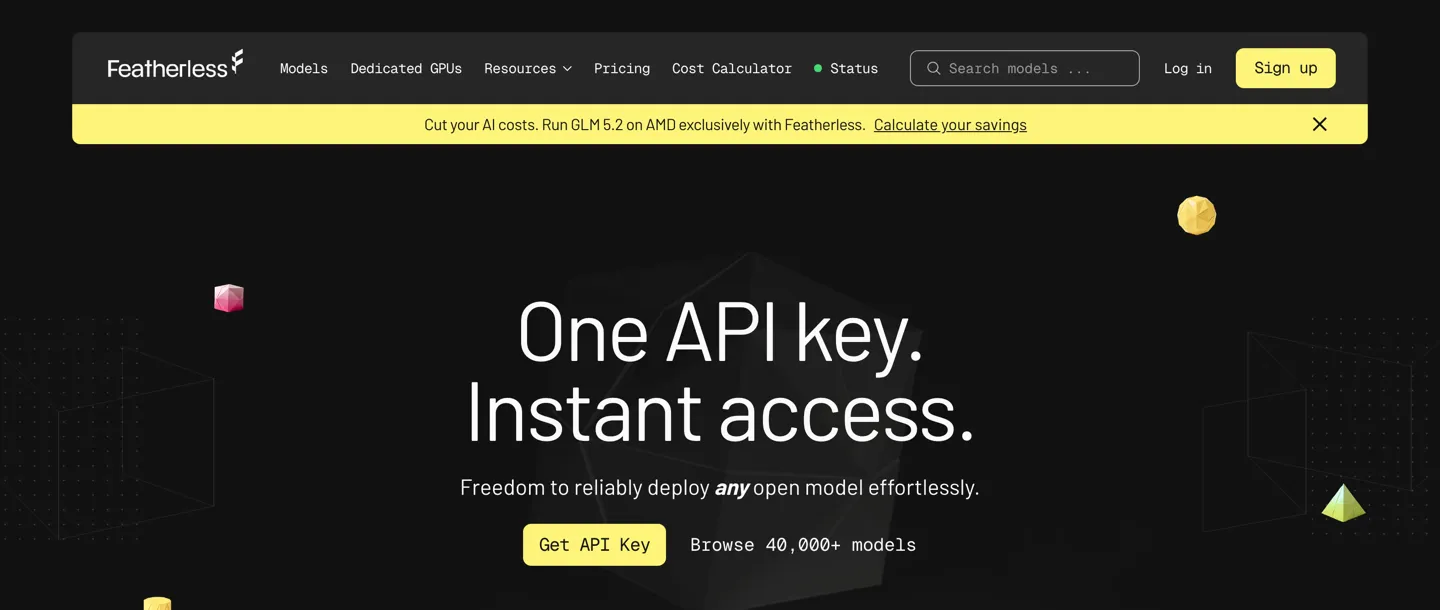 Featherless: one API key, 40,000+ open models, fixed price. The shape of what is coming.
Featherless is the next thing I will test when my Anthropic quota runs out again. Pay a fixed amount, run open models as much as you want. Their top plan, from what I can see, gives you two requests at once at a 256k context - a smaller window than GLM’s million, but two of them in parallel. One key, any model, flat price. That is the direction.
The one thing keeping me honest
Let me end where the podcast started, because it is the thing I keep having to remind myself.
Open-source already wins on token price, on economics, on privacy. Where it still loses is cost per unit of intelligence. A token is cheap, but if a weaker model burns three times as many of them to finish your task - or does not finish it at all - the cheap token was a trap. Give a genuinely hard job to a weak model like Gemma 4 (which providers now hand out for free, that is how far the floor has dropped) and it will spend a fortune of tokens and maybe still miss. The frontier models, Fable and Sol, are still cheaper per solved problem today. That gap is real, and I am not going to pretend it is not.
But it is closing. It has been closing all year, and everything above is the sound of it closing: a good-enough open model, half a dozen shops racing to serve it, a flat-rate plan with a real key, an all-you-can-eat future taking shape. Inference is becoming hosting. And once it fully does, the labs charging frontier prices for the model itself are competing with a WordPress.
I am building on the side of that I can control. Slower, more work, a little more boring. But mine.